

The three things Google weighs
Google says it ranks local results on relevance, distance and prominence, and that is honest. Relevance is whether your profile and website match the search: the right primary category, the services listed, the words on your pages. Distance is how far the profile’s pin is from the searcher, or from the place named in the search. Prominence is how well known the business looks: reviews, their recency and content, mentions on other sites, and the strength of the website.
You cannot change distance except by moving. You can change relevance in an afternoon and prominence over a few months. Most businesses outside the top three have a relevance problem first, which is the good news, because it is the fastest to fix.
Why your rank changes street by street
Because distance is one of the three factors, the result shifts as the searcher moves. On the Gold Coast, with businesses strung along the M1 and the coast, this matters more than in a compact city. A detailer in Nerang might own Nerang and Carrara and lose Robina to a competitor two kilometres closer. Neither business is "ranked first"; each has a territory.
The job is to make your territory as big as the service area you actually work, and to know where its edges are.
| Business | Search | Before | After | Days between |
|---|---|---|---|---|
| Gold Coast plumber | "best plumber" + suburb | Top 3 at 40 of 49 points, avg 1.82 | Top 3 at 46 of 49, avg 1.45 | 65 |
| Perth plumber | "plumber" + suburb | Number 1 at 5 of 49 points, avg 1.94 | Number 1 at 49 of 49, avg 1.00 | 35 |
| Polish Hub Marine Detailing | boat detailing | Outside top 10 on most of the grid | Top 3 on most of the grid | 2 |
How a ranking grid scan works
A grid scan runs the same search from a lattice of points around the business, usually 7 by 7 or 9 by 9, spaced a kilometre or so apart, and records your position at each point. The result is a heatmap: green where you are in the top three, yellow where you are close, red where you are not on the first page. Two scans on the same grid, weeks apart, show exactly what moved.
I use Local Falcon for this. The case studies on this site are those scans: a Gold Coast plumber in the top three at 40 of 49 points in July and 46 of 49 in October; a Perth plumber at number one on 5 of 49 points, then all 49 five weeks later. The numbers under each grid are the average position across the grid and the share of points in the top three.
What moves a business into the top three
- The right primary category and a complete services list. This alone has moved profiles from page two to the pack in days.
- A website that says the same thing as the profile, with a page per service and per suburb.
- Reviews that keep coming and mention the service and the suburb in words.
- Photos and posts that prove the business is alive this month.
- Citations that agree: the same name, address and phone on the directories Google trusts.
- Time, and the weekly work. Rankings drift the moment the work stops.
Things that do not work, and some that get you suspended
- Keyword stuffing the business name ("Joe’s Plumbing Gold Coast Emergency 24/7"). A violation, and competitors report it.
- A fake address or a virtual office to get a pin somewhere better. Suspension, and reinstatement can take months.
- Buying reviews. Google is better at spotting them than people think, and the penalty outlasts the gain.
- Spamming posts with the same keyword. No effect on rank; posts help by proving activity, not by repetition.
Checklist
Read your own Maps position properly
- Search your main service from your business address, then from a friend’s house three suburbs away. Note both.
- Check the primary category on your profile against the top three competitors. If theirs is more specific, that is the gap.
- Count the services on your profile. Fewer than ten is a relevance problem.
- Look at the date of your newest review and newest photo. Older than a month is a prominence problem.
- Get a grid scan before changing anything, so the after means something.
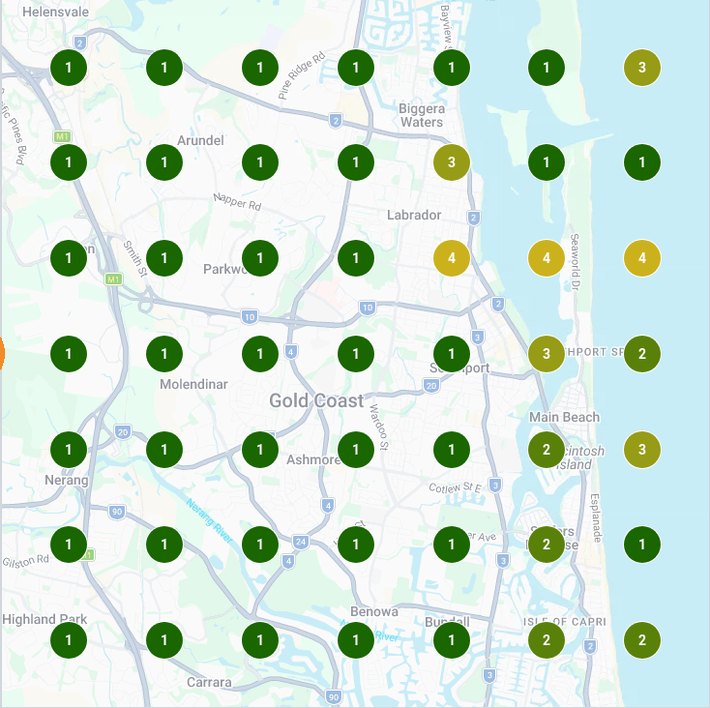
A finished ranking grid: a Gold Coast plumber in the top 3 at 46 of 49 scan points, 1 October 2026. Every engagement starts and is measured with a scan like this.