

How an AI answer picks a local business
When someone asks an AI assistant for a recommendation in a specific place, the model does three things quickly. It works out what kind of business is being asked for and where. It pulls in whatever it can read about businesses of that kind in that place: web pages, directory profiles, review snippets, Maps data where it has access. Then it writes an answer that names the businesses it is most confident are real, relevant and reputable.
Confidence is the key word. A model will not name a business it is not sure about. It becomes sure when the same facts show up in several independent places and agree with each other: the name, the suburb, the services, the phone number, the kind of work, the reviews. It becomes unsure when the record is thin, contradictory or spread across old brand names and dead pages.
- Entity clarity: one business name, one address, one phone number, everywhere
- Topical clarity: pages and a profile that plainly say what you do and where
- Corroboration: directories, reviews, mentions and case studies that agree with your own site
- Readability: facts stated in plain HTML text, not buried in images, sliders or PDFs
- Recency: signs the business is alive this month, not in 2021
What GEO shares with local SEO, and where it differs
Most of GEO is local SEO done thoroughly. A complete Google Business Profile, a website with a page per service and per suburb, consistent citations, steady reviews: those are the inputs for both. If you are already in the top three on Maps for your searches, you are most of the way there.
The differences are in emphasis. Maps leans on distance and the profile. AI answers lean on what can be read and cross-checked, so the website and third-party mentions carry more weight. Maps rewards one strong profile. AI answers reward a business that is described the same way in five places. Maps does not care whether your facts are in a table; a model finds a table easier to quote than a hero image.
| Signal | What Google Maps does with it | What an AI assistant does with it |
|---|---|---|
| Business Profile | Primary ranking input, with distance | One source among several; must agree with the website |
| Website service pages | Relevance for the profile and organic rankings | The main thing it reads and quotes; plain text wins |
| Reviews | Prominence and click-through | Evidence of reputation; the words in reviews get read |
| Directories and citations | Consistency check | Corroboration: more agreeing sources, more confidence |
| Case studies with numbers | Little direct effect | Strong: specific, dated claims the model can cite |
What I do on an AI search engagement
- Baseline. I ask the main assistants the questions your customers ask, in fresh sessions, with the location set, three times each. I record who gets named, who gets cited and what they say about you, including mistakes.
- Entity clean-up. Business name, address, phone, categories and services made identical across your Business Profile, website, Bing Places, Apple Business Connect, the main Australian directories and your social profiles. Old brand names and dead URLs redirected or retired.
- Plain-text facts. Every page that matters gets its key facts in HTML text: what you do, where, for whom, since when, what it costs to find out more. Structured data (LocalBusiness, Service, FAQ, Person) describing the same facts.
- Proof the models can read. Case studies with dates, numbers and limitations in text, not screenshots alone. Reviews that mention the service and the suburb. Third-party pages that name you for the right thing.
- Question pages. The questions customers actually ask an assistant, answered on your site in your words, so the model has a source to quote.
- Re-test monthly. Same questions, same method, compared with the baseline. Fix the pages that miss.
What the assistants are reading
Each assistant draws on a slightly different record, which is why the entity clean-up goes wider than Google. Copilot and the Bing-backed tools lean on the Bing index and Bing Places. Google AI Overviews and AI Mode draw on the normal Google index and your Business Profile. ChatGPT with search on reads live web pages and tends to favour sources that state facts plainly and are corroborated elsewhere. Perplexity cites its sources openly, which makes it the easiest to diagnose.
What this cannot do
- It cannot make a model name a business with no reviews, no website and a half-finished profile. The inputs have to exist.
- It cannot guarantee a mention. The models change, the answers vary between sessions, and the comparison is a sampled rate, not a rank.
- It does not replace Maps. Most local searches still go through Google, and the Maps pack still sends most of the calls.
Checklist
Ten-minute AI visibility check for your own business
- Open ChatGPT in a fresh session, set your suburb, and ask "Who should I call for [your service] in [suburb]?" three times. Are you named? Cited?
- Google your business name plus your suburb. Does every result show the same name, address and phone?
- Open your main service page. Could a stranger tell in ten seconds what you do, where and for whom, from the text alone?
- Read your last ten reviews. Do any of them say the service and the suburb in words?
- Search Bing for your business. Is there a Bing Places listing, and is it right?
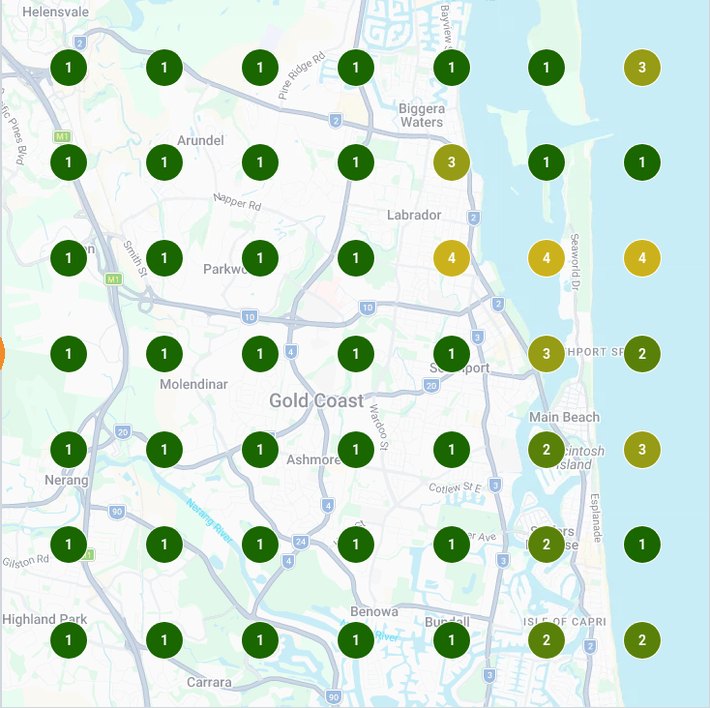
A finished ranking grid: a Gold Coast plumber in the top 3 at 46 of 49 scan points, 1 October 2026. Every engagement starts and is measured with a scan like this.