

What building customers search, and when
- Discovery: "renovation builder [suburb]", "home builder Gold Coast", "builders near me". The Maps pack and the first page; this is where the shortlist forms.
- Project type: "kitchen renovation builder", "second storey addition", "granny flat builder", "deck builder", "bathroom renovation". Wants a page per project type.
- Cost and process: "how much does a renovation cost on the Gold Coast", "how long does a second storey take". Wants honest ranges and a process, not "contact us for a quote".
- Trust: "[your business] reviews", "QBCC licence check". Wants the licence, insurance, and reviews that name finished projects.
The profile set-up for a builder
- Primary category that matches the main work: "Home builder", "Remodeler" (Google’s word for renovation builder), "Construction company" for commercial. Not "Contractor".
- Services named by project: kitchen renovations, bathroom renovations, extensions, second storeys, decks and pergolas, granny flats, new homes, knock-down rebuilds.
- A description that says what you build, where, and your QBCC licence number.
- Photos organised by project, with before and after, and new ones every month while jobs are running.
- Reviews from finished projects, requested at handover when the client is happiest.
| Plumber | Builder | |
|---|---|---|
| Typical search | "plumber near me", tonight | "renovation builder [suburb]", over weeks |
| Where it is won | Maps pack, Call button | Shortlist from Maps, decided on the website |
| Reviews | Volume and recency | Fewer, each one detailed |
| Pages that matter | Service and suburb pages | Project pages with real jobs, process, cost guide |
The pages a builder’s website needs
Project pages are the whole game. One page per project type, each with three or four real projects on it: the brief, the suburb, the problem with the house, what you did, how long it took, and photos. A general "our services" list does not win an eighty-thousand-dollar job; a page that shows you have rebuilt three Queenslanders in Beenleigh does.
- A page per project type, with real projects and photos
- A process page: first call, site visit, concept, fixed price, build, handover, with rough timelines
- An honest cost guide: ranges for the common jobs on the Gold Coast, and what moves the price
- Suburb pages for the areas you build in, with the housing stock named: post-war in Southport, new estates in Pimpama, acreage in Willow Vale
- Licence, insurance, warranty and the owner on every page
Reviews that win building jobs
A builder gets fewer reviews than a plumber, so each one has to work harder. Ask at handover, in person, and follow with the link. Ask the client to say what was built, where, and what it was like to live through. A review that says "second storey in Coomera, on time, kept the site clean, communicated every week" answers the three fears every renovation client has.
Where builders usually lose
- A beautiful website with no suburb or project type in the text, so Google cannot tell what you build or where.
- Photos in a gallery with no captions, which neither Google nor an AI assistant can read.
- No cost information at all, so the researcher leaves for a competitor who gave a range.
- A profile category of "Contractor" competing against "Home builder".
- Reviews that stopped when the last big job finished.
Checklist
The builder website check
- Does each project type have its own page with real projects on it?
- Does every photo have a caption that names the job and the suburb?
- Is there a process page with timelines?
- Is there any cost information at all?
- Is the QBCC licence number on every page?
- Did you get a review at your last handover?
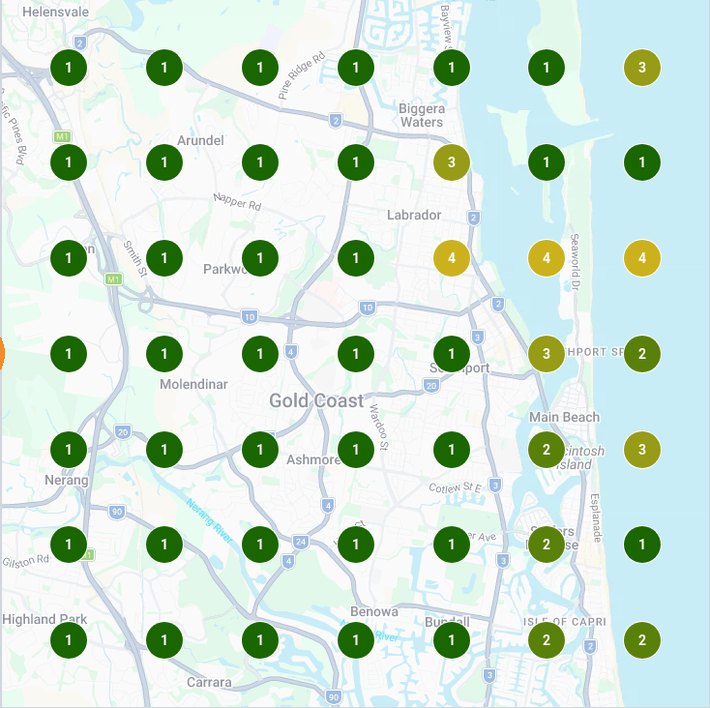
A finished ranking grid: a Gold Coast plumber in the top 3 at 46 of 49 scan points, 1 October 2026. Every engagement starts and is measured with a scan like this.