

Why recent reviews beat a big old pile
Google weighs review recency and velocity, not just the total. A business with 60 reviews and three new ones a month usually outranks one with 300 reviews and nothing since 2023, because the second looks like it might have closed. Customers read it the same way: the first thing most people check is the date of the newest review.
The target is not a number. It is a rhythm. One or two reviews a week, every week, mentioning the job and the place.
The request system that actually gets reviews
- Ask at the right moment: when the job is done and the customer is pleased, not three weeks later in a newsletter.
- Make it one tap. A direct link to the review form, sent by text from the business number, with the customer’s name in the message.
- Say what to write, without scripting it: "If you could mention the job and the suburb, it helps other people find us."
- Follow up once, three days later, if nothing lands. Then stop.
- Track who was asked and who reviewed, so nobody is asked twice and the rate can be measured.
| Review says | Customer reads it as | Google reads it as |
|---|---|---|
| "Great service, thanks" | Fine, but vague | Positive sentiment, nothing else |
| "Fixed our hot water in Coomera same day" | Specific, believable, recent | Service + suburb + speed: relevance |
| "Second time we have used them" | Trust | Repeat business, prominence |
| Owner reply naming the job | A business that pays attention | Engagement, more words to read |
Why the words in reviews matter for ranking
Google reads reviews. A review that says "fixed our blocked drain in Pimpama the same afternoon" tells Google three things your profile might not: the service, the suburb and the speed. Across fifty reviews, those words add up to relevance for searches you never wrote a page for. That is why the request message nudges customers toward the job and the place, and why generic "great service" reviews, while welcome, do less.
Replies: what to say and why it counts
- Reply to every review within a day. Google shows the reply, and customers read them to see how you handle people.
- Thank the reviewer by name, name the job and the suburb back, and keep it to three sentences.
- For a negative review: acknowledge, state the facts briefly, take it offline with a direct number. Never argue in public.
- Replies are written in the owner’s voice. If I write them, they sound like you, and you see them first.
Fake, unfair and competitor reviews
Google removes reviews that break its policies: no real experience, conflict of interest, spam, off-topic. It does not remove reviews just because they are unfair. The process is to flag the review with the specific policy it breaks, follow up through the Business Profile support channel with evidence, and reply publicly in the meantime so other readers see your side. Most honest removals take one to three weeks. Some never happen, and the answer then is to bury it with real reviews.
What not to do
- Do not buy reviews or swap them with other businesses. Google detects patterns and the penalty is a filtered profile.
- Do not gate reviews, asking happy customers for Google and unhappy ones for a private form. It is against policy.
- Do not offer discounts for reviews. Also against policy, and it shows in the wording.
- Do not let staff review the business. Conflict of interest, and easy to spot.
Checklist
The review health check
- Newest review in the last 14 days?
- At least one review a week over the last two months?
- Every review replied to?
- Do half your recent reviews mention a service or a suburb?
- Is the review link on your invoice, your SMS template and your email signature?
- Any review that breaks policy still sitting unflagged?
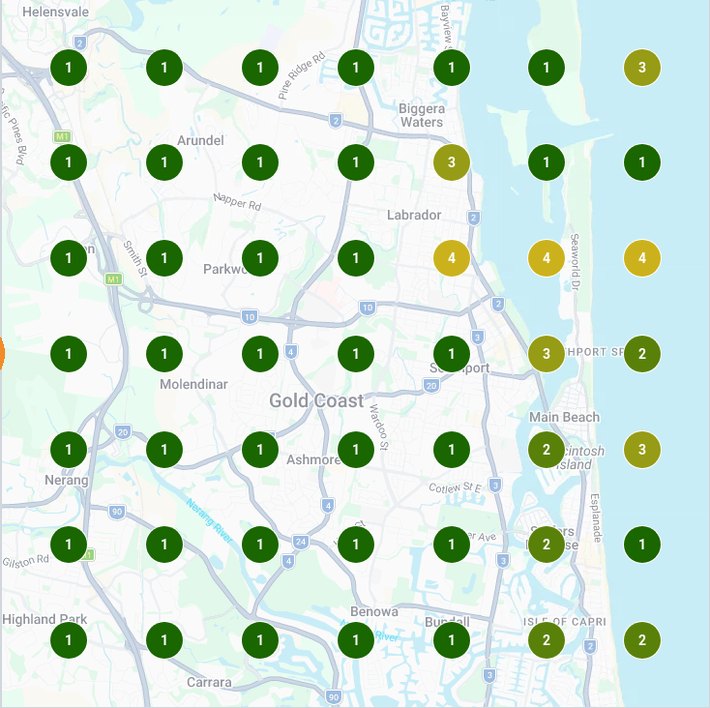
A finished ranking grid: a Gold Coast plumber in the top 3 at 46 of 49 scan points, 1 October 2026. Every engagement starts and is measured with a scan like this.